Selecting an appropriate drysuit requires understanding thermal protection ratings, seal integrity, and material durability. The 2026 market presents several technologically advanced options engineered for different diving environments and body types. Each model incorporates distinct features affecting comfort, longevity, and safety performance. The following analysis examines leading drysuits across key specifications to inform your selection process.
Recommended Drysuits for Scuba Diving

Key Takeaways
- Material Quality Matters: Trilaminate construction offers superior abrasion resistance, while neoprene provides targeted insulation for extended cold-water diving comfort.
- Thermal Insulation Ratings: Choose suits with graduated thickness (8/7/6mm) or dual fleece padding to maintain body temperature in varying water conditions.
- Sealing Systems: Metal dry zippers and Si-Tech balanced valve systems ensure effective waterproofing and easy self-donning for recreational and technical divers.
- Fit and Mobility: Snug, adjustable seals prevent water entry while flexible materials like lightweight neoprene enable comfortable movement during extended underwater exploration.
- Maintenance and Durability: Hand-wash care, proper storage, and regular zipper inspection preserve drysuit longevity and ensure reliable waterproof performance for multiple seasons.
Hollis 8/7/6mm NeoTek V2 Unisex Hooded Semi-Dry Suit – XX-Large
The Hollis 8/7/6mm NeoTek V2 Unisex Hooded Semi-Dry Suit represents an ideal choice for underwater adventurers requiring thermal protection across varying water temperatures, as its graduated neoprene thickness—8mm torso, 7mm arms, and 6mm legs—delivers targeted insulation while maintaining mobility in critical articulation zones. The suit employs compression-resistant and super-stretch neoprene for durability and comfort. Its ThermaSkin inner liner improves thermal retention, while the G-lock horizontal front zipper with internal bib reduces water infiltration. Neck, wrist, and ankle internal dams provide additional sealing. Manufactured in the USA or imported, this semi-dry suit accommodates XX-Large dimensions. Hand washing maintains material integrity and extends operational lifespan.
Best For: Divers and water sports enthusiasts seeking thermal protection across varying water temperatures with a semi-dry suit that balances insulation and mobility.
Pros:
Cons:
SCUBAPRO mens Definition Dry Hd Drysuit

SCUBAPRO’s Men’s Definition Dry HD Drysuit represents a superior choice for adventurers requiring extended bottom time in cold-water environments. The heavy-duty poly/butyl/poly trilaminate construction guarantees years of reliable performance under aggressive submersion conditions. The front diagonal BDM metal dry zipper promotes water-resistant self-donning, while stitched, glued, and double waterproof taped seams maximize reliability. Durable latex wrist and neck seals provide efficient water blockage. Two large cargo pockets feature D-rings, blue bungee, high-security over-flaps, and hook-and-loop closures for secure equipment storage. A neoprene neck collar maintains hood placement and preserves the latex seal when wearing gloves, enhancing diver comfort and safety during extended missions.
Best For: Divers seeking extended bottom time in cold-water environments who prioritize durability and reliability during aggressive diving conditions.
Pros:
Cons:
Scubapro Mens Protection
Adventurers seeking dependable thermal protection in moderate-to-cold water conditions will find the hybrid construction of this suit particularly effective. The SCUBAPRO Men’s Protection integrates 4mm high-density neoprene with latex wrist and neck seals, delivering superior insulation through its orange plush interior lining and protective neoprene warm collar. The Si-Tech balanced valve system permits precise buoyancy control, minimizing depth-related variations that compromise stability. Semi-rigid attached plunge boots with soft soles provide secure footing on challenging underwater terrain. A heavy-duty rear shoulder-to-rear BDM metal zipper, protected by neoprene overflap reinforcement, guarantees long-term durability and reliable sealing performance, making this imported suit suitable for demanding underwater activities across recreational and professional applications.
Best For: Adventurers and professional divers seeking reliable thermal protection in moderate-to-cold water conditions who prioritize stability, durability, and secure footing on challenging underwater terrain.
Pros:
Cons:
SCUBAPRO Everdry 4mm Men’s Diving Drysuit (2XL Short)

For swimmers seeking lightweight comfort without sacrificing thermal protection, SCUBAPRO’s Everdry 4mm represents a significant progression in drysuit technology. Constructed from high-density neoprene weighing 50 percent less than traditional variants, this suit maintains compression resistance at depth while offering versatile undergarment options. The smooth-skin neck seal and ultra-smooth wrist seals minimize water infiltration. Si-Tech balanced valves provide precise buoyancy control vital for safe depth management. Printed shoulder and knee panels deliver critical abrasion protection during entries and exits. Attached neoprene socks promote inside-out cleaning and maintenance. The blue suspender system guarantees secure fit, while I-Safe arm straps accommodate wrist-mounted instruments. The warm plush interior improves thermal comfort during extended underwater operations.
Best For: Divers who prioritize lightweight comfort and thermal protection while needing reliable buoyancy control and durability for freshwater and moderate saltwater diving conditions.
Pros:
Cons:
SCUBAPRO K2 Extreme One-Piece Men’s Diving Undersuit (Large)

The K2 Extreme undersuit addresses a critical requirement for cold-water plunging: maintaining core temperature while preventing suit squeeze and material degradation. Constructed from breathable, stretchy dual fleece, this one-piece steamer provides thermal insulation while allowing dampness management. Compression padding on shoulders, chest, and knees improves protection and reduces suit compression effects. Elastic wrist loops and heel straps prevent garment migration during drysuit wear, maintaining thermal efficiency throughout the plunge. The front double-slider zipper facilitates efficient donning and doffing procedures. Imported and patterned after SCUBAPRO’s proven Everflex 1.5mm line, the K2 Extreme represents the manufacturer’s commitment to safety-focused thermal protection for plunging professionals and enthusiasts.
Best For: Cold-water divers and diving professionals who need reliable thermal protection with drysuit compatibility and minimal suit squeeze.
Pros:
Cons:
BARE Polar Xtreme Full Suit for Drysuit Scuba Diving

BARE’s Polar Xtreme Full Suit represents an ideal undergarment choice for scuba enthusiasts requiring superior thermal protection in cold-water environments. The suit integrates Primaloft Gold Insulation with Cross Core Technology to deliver exceptional warmth retention while maintaining breathability and compression resistance. Its construction features a durable stretch polyester exterior paired with a soft fleece interior for peak heat preservation. Practical design elements include an extended front zipper for accessibility, hand warmer pockets, thumb loops for sleeve stability, and stitched buttonholes for P-valve integration. Quick-dry material promotes efficient moisture evaporation post-immersion. Manufactured by BARE, a British Columbia-based company with five decades of expertise in underwater equipment innovation, this suit guarantees reliable performance and durability for demanding drysuit applications.
Best For: Cold-water scuba divers who need superior thermal protection and reliable performance in demanding drysuit diving conditions.
Pros:
Cons:
Hollis DX-300X
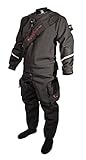
Expedition-grade diving demands a suit engineered by practitioners who understand technical requirements at depth. The Hollis DX-300X represents three years of development in demanding conditions, featuring a 700 g/sq. trilaminate construction with heavy-duty Cordura Ripstop outer protection and 12-layer Butyl Mass middle layer for chemical and ozone resistance. Its 25% extra stretch, facilitated by bias-cut panels, improves mobility while maintaining integrity. Critical safety features include 3M reflective strips, double-thickness kneepads, and wide flat seams minimizing leak risks. The SiTech silicone seals allow quick replacement during expeditions. Two large thigh pockets with internal D-rings provide vital gear storage. Chest-mount inflation and shoulder-mount exhaust valves optimize operational efficiency for technical diving operations.
Best For: Technical divers undertaking expedition-grade diving operations who prioritize durability, mobility, and safety in demanding underwater conditions.
Pros:
Cons:
Factors to Consider When Choosing Drysuits for Scuba Diving
Selecting an appropriate drysuit requires evaluation of material durability, thermal insulation ratings, and sealing systems to guarantee both performance and safety in varied water conditions. Zipper type and accessibility mechanisms significantly impact ease of donning, doffing, and emergency procedures, making them critical design considerations. Comfort and fit directly influence thermal protection effectiveness and reduce fatigue during extended underwater exposure.
Material Durability and Construction
The durability and construction quality of a drysuit directly impact its performance longevity and protective capability in demanding swimming environments. Material selection determines resilience across varied conditions. Trilaminate fabrics, particularly poly/butyl/poly constructions, deliver superior abrasion resistance vital for aggressive diving. Neoprene suits with compression-resistant and super-stretch designs balance insulation with mobility while maintaining structural integrity.
Strategic reinforcement in high-stress zones—including double-thickness knee pads and robust seam construction—minimizes leak risk and extends operational lifespan. Advanced thermal technologies integrated throughout boost insulation efficiency, while quick-dry materials promote rapid humidity management critical for maintaining warmth in cold water. Divers should prioritize suits combining heavy-duty fabric composition with reinforced construction features to guarantee reliability and safety during extended underwater operations.
Thermal Insulation Ratings
While durable construction establishes a drysuit’s structural integrity, thermal insulation ratings determine its capacity to maintain core body temperature in cold water environments. Neoprene thickness—typically ranging from 4 mm to 8 mm—directly correlates with warmth retention, though compression at depth can diminish effectiveness. Internal linings, such as plush or fleece materials, significantly improve thermal protection and comfort during extended immersions.
Advanced technologies like multilayer insulation systems and Primaloft materials offer superior warmth-to-weight ratios, optimizing performance without excessive bulk. Divers must balance insulation thickness with flexibility to maintain mobility and reduce buoyancy complications.
Selecting appropriate insulation ratings requires matching the drysuit to specific diving environments, water temperatures, and dive duration. Proper thermal insulation directly impacts safety, comfort, and buoyancy control throughout the immersion.
Sealing Systems and Water Resistance
Since water infiltration compromises drysuit effectiveness and swimmer safety, sealing systems represent one of the most critical components in drysuit design. Latex and neoprene seals at the neck, wrists, and ankles create primary barriers against water entry, with smooth-skin neoprene offering durability and latex providing superior water-tight performance.
Modern drysuits employ reinforced front diagonal zippers that improve water resistance while facilitating self-donning and doffing. Additional neck collars further maintain proper seal placement and prevent water bypass. High-quality construction involves triple-layer protection: stitching, adhesive bonding, and waterproof tape sealing of all seams.
These integrated systems work synergistically to maintain complete water integrity throughout extended underwater missions, directly correlating with diver safety and thermal protection effectiveness.
Zipper Type and Accessibility
How critical is zipper selection to drysuit performance and plunge safety? Zipper type directly influences water resistance and durability. Metal zippers typically outperform plastic alternatives in sealing integrity and longevity, making them preferable for demanding plunging environments.
Front diagonal zippers facilitate efficient self-donning and doffing, reducing pre-plunge preparation time and physical exertion. Waterproof taped seams around zipper installations are mandatory for maintaining the suit’s watertight integrity at vulnerable connection points.
Accessibility features warrant careful evaluation. Larger zippers with easy-grip pulls accommodate gloved operation, critical when divers require quick adjustments underwater. Designs incorporating smooth closure mechanisms and snag-resistant technology minimize operational friction and improve reliability during extended submersion.
These considerations collectively determine whether a drysuit provides reliable performance throughout a plunge’s duration.
Comfort and Fit Considerations
A drysuit’s fit fundamentally determines both safety and performance underwater. A snug fit prevents water intrusion while maintaining sufficient mobility across critical joints—particularly the shoulders and hips—where restriction compromises submersion efficiency and safety.
Proper insulation layering balances thermal protection against bulk, which can impede movement and increase fatigue. Adjustable neck and wrist seals allow customization, reducing leakage risk and enhancing comfort during extended submersions.
Material selection significantly impacts usability. Breathable, flexible construction minimizes sweat accumulation and allows adequate range of motion, preventing discomfort and hypothermia. Smooth zippers and flexible seals make efficient donning and doffing easier, reducing preparation time and stress.
Divers should prioritize suits accommodating their specific body dimensions and diving profile, as ill-fitting drysuits compromise thermal protection, increase gas consumption, and raise accident risk.
Storage and Pocket Functionality
Beyond ensuring proper fit and thermal protection, swimmers must evaluate storage capacity and pocket design when selecting a drysuit. Multiple strategically positioned pockets allow swimmers to carry crucial equipment without compromising mobility or balance. Large cargo pockets with high-security closures, including hook-and-loop fasteners and protective over-flaps, prevent accidental loss of critical gear during underwater operations. D-rings and bungee attachment systems promote rapid tool access when needed. Pocket placement significantly impacts functionality; poorly positioned storage creates weight distribution issues and restricts movement during critical swimming phases. Effective pocket design balances accessibility, security, and ergonomics. Swimmers should assess their typical equipment requirements and verify that chosen drysuits provide appropriately sized, securely fastened, and preferably positioned storage solutions for their specific swimming applications.
Maintenance and Care Requirements
Proper maintenance directly determines drysuit longevity and operational reliability. Hand washing remains the only recommended cleaning method, as machine washing compromises material integrity and seal performance. Fresh water rinsing after each plunge—particularly following saltwater or chlorinated water exposure—prevents fabric degradation and seal deterioration.
Regular inspection of all zippers and seals identifies wear patterns and damage requiring immediate repair. Proactive maintenance prevents catastrophic failure during critical plunges.
Environmental storage conditions significantly impact drysuit durability. Cool, dry locations away from direct sunlight preserve material quality and prevent premature deterioration. Operators must avoid exposing drysuits to extreme temperatures and chemical substances that accelerate material breakdown.
These maintenance protocols guarantee consistent operational readiness and extend equipment service life substantially.
Conclusion
Like a fortress protecting its inhabitants, a properly selected drysuit serves as the critical barrier between diver and harsh aquatic environments. The seven models reviewed—from the Hollis NeoTek V2’s graduated insulation to the SCUBAPRO Everdry’s lightweight construction—demonstrate industry-leading thermal protection and durability standards. Prioritizing seal integrity, material quality, and fit guarantees ideal safety during extended underwater operations. Selecting appropriate thermal protection remains non-negotiable for maintaining core body temperature and preventing hypothermia-related incidents.