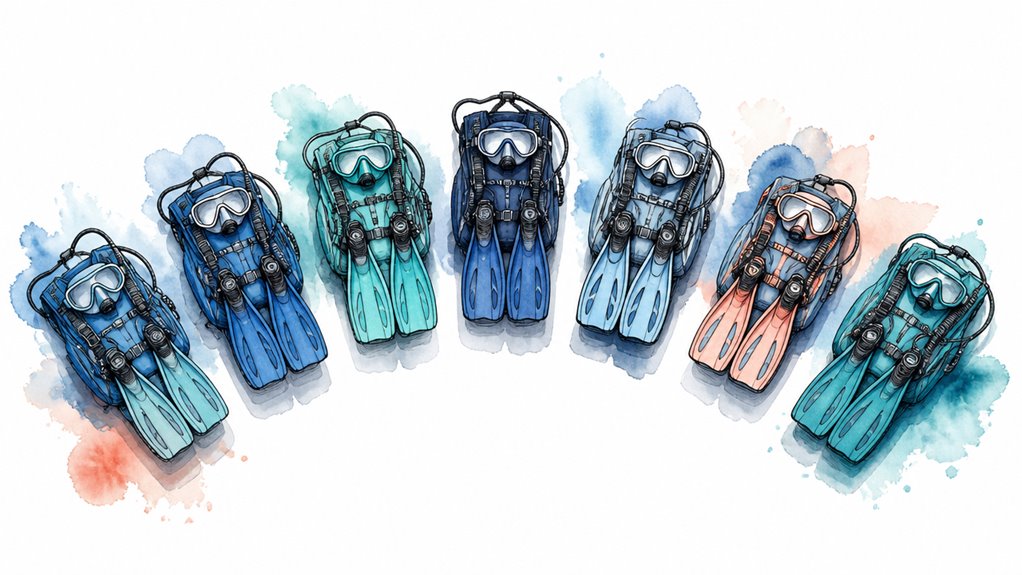
Selecting the appropriate buoyancy compensator device (BCD) remains crucial for underwater safety and immersion performance. The market presents multiple configurations—jacket styles, wing systems, and travel-oriented designs—each engineered for specific diving conditions and user profiles. Understanding the technical distinctions between leading models becomes vital before committing to equipment that directly impacts buoyancy control and emergency procedures.
Recommended BCDs for Scuba Diving


Key Takeaways
- High-lift capacity BCDs like Cressi models suit recreational and professional divers with heavy gear configurations.
- Travel-focused options such as Cressi Lightest BCD weigh 5.5 pounds and fold for portability.
- Streamlined designs like Mares Pure SLS reduce underwater drag for improved buoyancy control and efficiency.
- Durable materials require minimum 500 Denier Cordura construction with thermal welding for longevity and safety.
- Multiple dump valves and integrated compartments enhance redundancy and gear management across performance levels.
TUSA Liberator Sigma II BCD Jacket

The TUSA Liberator Sigma II BCD Jacket represents an excellent choice for snorkelers requiring reliable stabilization and efficient weight management during underwater operations. This model features an Ultimate Stabilizing Harness and Advanced Weight Loading System (A.W.L.S) designed to optimize buoyancy control and comfort during extended immersions. Constructed from durable 500D Cordura nylon, the jacket incorporates two dump valves—one OPEV and one additional valve—for precise air evacuation. The equipment includes one stainless steel d-ring and four resin d-rings for secure gear attachment. Two large double-zippered pockets provide accessible storage for important immersion accessories. With a lift capacity of 22 pounds (10.2 kgf) in small sizes, this BCD delivers dependable performance for recreational diving applications.
Best For: Recreational divers and snorkelers who need reliable buoyancy control, efficient weight management, and durable equipment for extended underwater activities.
Pros:
Cons:
Cressi Scuba Diving Jacket BCD High-Lift Capacity
Diving centers and professional operators requiring a reliable, high-capacity buoyancy compensator will find Cressi’s jacket-style BCD ideal for demanding operational environments. Constructed from Cordura 500 Denier with internal thermal welding and sectored tubes, the design delivers exceptional durability and lift capacity through oversized lateral lobes. The reinforced neck prevents damage from tank impact. Three dump valves—two manual pullers and one integrated with the inflator hose—provide redundant venting capability. Integrated compartments secure the air pressure gauge and octopus regulator. Large-capacity pockets with robust zippers offer practical storage. A double air filtering system and easily disassembled construction suit frequent cleaning in sandy environments.
Best For: Diving centers and professional operators who need a reliable, durable buoyancy compensator designed for frequent use in demanding environments.
Pros:
Cons:
CRESSI Scuba Diving Package Pro Pack Made in Italy
Beginner divers seeking a thorough scuba package tailored for warm and temperate waters will find the CRESSI Scuba Diving Package Pro Pack an ideal choice. This Italian-manufactured system integrates the Start Pro 2.0 BCD, constructed from durable 1000/500 Denier Cordura with quick-release buckles and dual air filtration. The AC2/Compact regulator features a performant piston first stage with one high-pressure and four low-pressure ports. The included Octopus Compact guarantees redundancy, while the Digi2 console provides real-time digital monitoring of depth and air supply through large, legible displays. Designed and assembled by Cressi since 1946, this thorough package carries a two-year limited warranty, prioritizing safety and reliability for novice divers.
Best For: Beginner divers looking for a comprehensive, reliable scuba package suitable for warm and temperate water environments.
Pros:
Cons:
Mares Pure SLS Scuba Diving Buoyancy Compensator BCD

Mares Pure SLS stands as an exceptional choice for swimmers seeking a balanced blend of performance, comfort, and accessibility across all experience levels. The streamlined design reduces underwater drag, enhancing buoyancy control efficiency. Its SLS weight management system facilitates intuitive weight adjustments with visual safety confirmation—critical for aquatic operations. Swivel shoulder buckles and an adjustable waist strap accommodate diverse body types while maintaining stability. The roll-down cargo pocket provides practical storage for diving accessories. Weighing 3.9 kg and constructed from durable nylon, the Pure SLS delivers reliable performance. Customer ratings of 4.4 out of 5 stars reflect consistent user satisfaction, positioning it as a dependable option for recreational diving applications.
Best For: Divers of all experience levels seeking a reliable, comfortable buoyancy compensator that balances performance with accessibility and travel convenience.
Pros:
Cons:
Cressi Durable Start Jacket Style BCD Scuba Diving
The Cressi Durable Start represents an ideal choice for novice plungers and commercial immersion operations seeking reliable buoyancy control without operational complexity. Engineered by the Italian manufacturer established in 1946, this jacket-style BCD incorporates 1000 Denier Cordura construction, delivering improved erosion resistance and extended durability. The independent waist strap mechanism permits secure fit adjustments without restricting respiratory comfort. A dual-stage air filtration system promotes rapid debris removal during field rinsing. The thermoplastic backplate, coupled with rubber tank dampers and optional secondary strapping, establishes consistent equipment positioning while maintaining lightweight portability. These specifications establish the Durable Start as a dependable platform for developing fundamental buoyancy management competencies.
Best For: Beginners and dive centers seeking an easy-to-use, comfortable buoyancy control device without operational complexity.
Pros:
Cons:
Mares Pure SLS Scuba Diving Buoyancy Compensator BCD
Explorers seeking a versatile buoyancy compensator that performs across all skill levels will find the Mares Pure SLS a reliable choice. The streamlined design minimizes drag, enhancing underwater efficiency and control. Swivel shoulder buckles guarantee secure positioning while maintaining freedom of movement, critical for executing proper diving techniques. The Smart trim weight positioning system optimizes buoyancy balance, reducing fatigue during extended explorations. The intuitive SLS weight system provides visual confirmation of proper pouch insertion, eliminating insertion errors. An adjustable waist strap and roll-down cargo pocket offer practical customization for diverse body types and travel scenarios. This unisex design accommodates beginners developing foundational skills through advanced divers requiring dependable equipment for demanding conditions.
Best For: Divers of all skill levels seeking a versatile, reliable buoyancy compensator that delivers streamlined performance and intuitive weight management across diverse diving conditions.
Pros:
Cons:
Cressi Lightest Travel Scuba Diving BCD Folds
For frequent travelers and liveaboard snorkelers seeking minimal luggage impact, Cressi’s Lightest Travel BCD delivers exceptional portability without compromising functional capacity. Weighing merely 5.5 pounds in size medium, this back-inflation design folds completely for carry-on compliance. The air bladder architecture guarantees natural weight distribution during descent and ascent. With lift capacity reaching 160 newtons and reinforced by dual dump valves, the BCD maintains precise buoyancy control. Eight D-rings, dual lateral pockets, and dual rear trim pockets—each holding 4.5 kilograms—provide extensive gear attachment and weight integration. The anatomic inflator features double air filtration, safeguarding against valve degradation. Adjustable padded shoulder straps and a quick-release cummerbund facilitate secure positioning across varying body types and diving conditions.
Best For: Frequent travelers and liveaboard divers who need a lightweight, packable BCD that doesn’t compromise on buoyancy control and gear attachment options.
Pros:
Cons:
Factors to Consider When Choosing a BCD for Scuba Diving
Selecting an appropriate buoyancy control device requires evaluating multiple critical factors that directly impact safety and performance underwater. Key considerations include lift capacity requirements tailored to the aquatic enthusiast’s weight and equipment configuration, material durability standards that withstand saltwater exposure and repeated use, weight management systems for precise buoyancy control, comfort and fit features that prevent chafing during extended wear, and inflation valve technology that guarantees reliable gas delivery. Each of these elements contributes to both the BCD’s functional effectiveness and the aquatic enthusiast’s overall safety in the aquatic environment.
Lift Capacity Requirements
Buoyancy control depends fundamentally on selecting a BCD with appropriate lift capacity, a specification that directly affects a diver’s ability to maintain neutral buoyancy and manage position throughout a plunge. BCD sizes typically range from 22 lb (10.2 kg) to over 36 lb (16.3 kg), accommodating diverse body types and equipment configurations.
Determining the correct lift capacity requires calculating total weight: diver body mass, exposure suit thickness, and all diving gear. Heavier equipment demands proportionally greater lift capacity. Thick wetsuits substantially increase buoyancy requirements, particularly in cold-water environments.
Matching lift capacity to planned activities and environmental conditions is crucial for operational safety. Undersized BCDs risk inadequate buoyancy control and emergency ascent complications. Oversized units may encourage overinflation, compromising stability and increasing decompression illness risk. Proper alignment guarantees predictable buoyancy management.
Material Durability Standards
A BCD’s longevity depends primarily on its fabric composition and construction methods. The industry standard of 500 Denier Cordura nylon provides exceptional resistance to abrasion and wear, critical for snorkelers operating in challenging environments. High-quality models employ reinforced stitching and thermal welding techniques to prevent structural failure, fraying, and tearing under repetitive stress.
Internal components—including valves and weight systems—must similarly meet rigorous durability standards to withstand the mechanical demands of frequent snorkeling operations. Material erosion resistance proves vital when exposure to sand and saltwater is inevitable.
Maintenance directly influences durability. Rinsing thoroughly after saltwater exposure and implementing proper drying protocols significantly extend operational lifespan. These preventive measures protect against corrosion and material degradation, ensuring consistent performance and safety across extended service life.
Weight Management Systems
Beyond the structural integrity of a BCD’s materials lies the similarly significant function of weight management systems, which directly influence a swimmer’s ability to achieve neutral buoyancy and maintain body positioning underwater. Integrated weight compartments and dedicated trim weight pockets facilitate precise weight distribution, enhancing stability and reducing fatigue during extended descents. Visual confirmation features for pouch insertion prevent accidental weight loss, a critical safety consideration. Quick-release buckles and accessible removal mechanisms are crucial for emergency situations, allowing divers to jettison weights rapidly if necessary. Modern systems balance accessibility with security, ensuring weights remain secure during normal diving operations while remaining readily removable when required. Evaluating a BCD’s weight management design is fundamental to selecting equipment that supports both comfort and safety underwater.
Comfort And Fit Features
While weight management systems establish the foundation for underwater control, comfort and fit features determine whether swimmers can execute vital movements and maintain focus during extended underwater operations.
A properly fitted BCD allows divers to maintain mobility and freedom of movement necessary for task execution and safety. Adjustable waist straps and padded shoulder straps provide personalized fit parameters, securing the device without restricting movement. Swivel shoulder buckles reduce chafing by accommodating natural body motion, minimizing discomfort during extended immersion.
Lightweight construction materials significantly improve comfort during prolonged wear and transport, reducing fatigue. Critically, proper fit establishes the foundation for underwater balance and stability, allowing divers to maintain peak buoyancy control and positional awareness throughout the dive profile. These features collectively boost operational effectiveness and dive safety.
Inflation Valve Technology
Multiple inflation valve systems form the mechanical foundation for precise buoyancy management, enabling underwater adventurers to maintain neutral buoyancy throughout descent and ascent profiles. Modern BCDs incorporate overpressure valves, dump valves, and inflator hoses—each component engineered to improve control and safety. Double air filtration systems prevent clogging, ensuring reliable airflow to the bladder during depth changes. Strategic dump valve placement promotes rapid weight release and buoyancy adjustments, critical for emergency responses in variable underwater conditions. Anatomic inflator handles optimize ease of operation, minimizing malfunction risk during critical moments. Divers should prioritize BCDs offering accessible valve configurations with responsive mechanisms, as these features directly impact safety margins and operational reliability across diverse snorkeling scenarios.
Conclusion
Selecting the appropriate BCD requires understanding individual immersion profiles and environmental conditions. While cost considerations may deter some divers, investing in quality buoyancy control equipment directly impacts safety and immersion duration. The seven models reviewed accommodate various body types, experience levels, and immersion styles. Prioritizing fit, weight distribution, and material durability guarantees reliable performance across freshwater and saltwater environments, ultimately justifying the expenditure through improved stability and emergency response capability.