The mini scuba tank market has matured significantly by 2026, offering equipment spanning 0.5L to 2.3L capacities with DOT certifications and advanced safety features. Selection demands careful evaluation of tank volume, refill compatibility, regulatory compliance, and intended immersion depth. Understanding these variables proves vital for both recreational divers and emergency preparedness. The following analysis examines seven leading models against critical performance criteria.
Recommended Mini Scuba Tank Kits


Key Takeaways
- Mini scuba tanks range from 0.5L to 2.3L capacity, offering 6-35 minutes of underwater breathing time depending on model and depth conditions.
- DOT and CE certifications, explosion-proof valves, and 6061 aviation aluminum construction ensure safety, durability, and seawater corrosion resistance for all quality tanks.
- Refill options include rapid station filling (4-16 seconds), air compressors (11-46 minutes), and hand pumps (30-50 minutes) for convenient accessibility.
- Lightweight portable designs with disassembly capabilities, carrying bags, and integrated backpacks make mini tanks ideal for travel and emergency rescue deployment.
- Annual inspections, pressure gauge monitoring, and universal adapter compatibility maintain reliability while supporting depths up to 33 feet for recreational diving scenarios.
Scuba Tank DOT Certified 1L Portable Diving Equipment
The Chikadip mini scuba tank represents an ideal choice for divers requiring emergency rescue capability and portable underwater operations. This DOT-certified 1L tank delivers up to 20 minutes of underwater time, contingent upon depth, temperature, and breathing rate. Constructed from 6061 aviation aluminum with 4mm walls, the tank withstands working pressures below 3000 PSI while featuring hard-oxidation spray coating for seawater corrosion resistance. Safety mechanisms include an air switch valve, constant pressure valve synchronized with breathing rhythm, and an explosion-proof valve venting automatically at 5000 PSI. The 8mm one-way inflation valve accommodates multiple refill methods, from electronic pumps requiring 15 minutes to hand pumps requiring approximately 50 minutes. Annual quality inspections guarantee continued reliability and safety compliance.
Best For: Divers and rescue personnel who need reliable emergency underwater breathing capability with a compact, portable design that can be quickly refilled and deployed.
Pros:
Cons:
Mini Scuba Tank Portable Refillable Diving Equipment
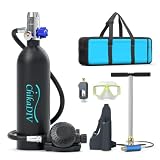
For recreational divers and beginners seeking portable backup air sources, mini scuba tank kits represent an essential safety apparatus. This 0.5L refillable tank delivers approximately 10 minutes of underwater breathing time at depths up to 33 feet, utilizing 6061 aviation aluminum construction for durability and corrosion resistance. The system features an explosion-proof valve with automatic pressure release, fluorescent pressure gauge for low-light visibility, and food-grade silicone mouthpiece. Multiple refill options include diving shop servicing, standard tank adapter connection, air compressor inflation, and high-pressure hand pump backup. The complete package includes a carrying bag, anti-lose rope, and hand pump. Mandatory annual inspections and hydrostatic pressure testing guarantee operational safety and compliance standards.
Best For: Recreational divers, beginners, and underwater professionals who need a portable backup air source for pool training, underwater photography, boat maintenance, and emergency situations.
Pros:
Cons:
SMACO Mini Scuba Tank 0.5L Portable Diving Cylinder
SMACO’s 0.5L Mini Scuba Tank stands as an exceptional choice for underwater enthusiasts requiring a reliable backup air source or extended bottom time during shallow explorations. The S300 model delivers up to 10 minutes of breathing capability at depths reaching 33 feet, with functionality as a backup source within 100 feet. Improved safety features include an external explosion-proof device and upgraded breathing valve core for smoother inhalation. A three-layer filtration system removes dust and impurities from intake air. Four inflation options accommodate diverse user needs: professional dive shop fills, rapid refill via standard tank adapter, dedicated air compressor charging, or manual hand pump inflation. Disassembly facilitates airplane transport, boosting portability for traveling divers.
Best For: Divers seeking a portable backup air source for shallow explorations or emergency situations who value portability and multiple inflation options.
Pros:
Cons:
2L Scuba Tank Kit with Backpack and Regulator
Portable plunging enthusiasts seeking extended underwater breathing capability will find this 2L scuba tank kit particularly suited to their needs. Constructed from high-quality 6061 aluminum and DOT-3AL certified, the kit operates at 3000psi working pressure with individual tanks tested at 5000psi for safety confirmation. The integrated backpack and regulator system provides approximately 25-30 minutes of underwater breathing time, though duration varies by individual consumption rates. A long-hose pressure gauge connection facilitates continuous tank monitoring during plunges. Weighing approximately 4.3kg, the portable design balances functionality with transportability. Newly manufactured stock from June 2025 guarantees product quality and reliability for recreational diving applications.
Best For: Recreational divers and portable diving enthusiasts seeking a lightweight, manageable underwater breathing solution for short to medium-length dives.
Pros:
Cons:
SMACO S700 Mini Scuba Tank 1.9L Portable Diving

The SMACO S700 delivers a thorough submersion solution in a 1.9-liter capacity system engineered for users requiring reliable underwater air access across multiple applications. This kit includes a diving tank, vest, mesh bag, and refill adapter, supporting up to 30 minutes of immersion time depending on depth, temperature, and breathing rate. The extended pressure gauge allows for real-time monitoring, while the integrated vest permits hands-free operation. Three refilling methods improve accessibility: DOT-compatible dive shops, SMACO’s 8mm adapter for 16-second refills from standard tanks, or the SMACO Air Compressor for 46-minute self-refilling cycles. An aluminum hard case simplifies air travel transport. Applications span recreational diving, rescue operations, boat inspections, and emergency backup air provision.
Best For: Divers seeking portable, reliable underwater air access for recreational diving, rescue operations, boat inspections, and emergency backup air in shallow water environments.
Pros:
Cons:
TUDIVING 0.5L Scuba Tank with Air Compressor

TUDIVING’s 0.5L scuba tank represents an excellent option for beginners and recreational adventurers seeking a compact, certified breathing apparatus. Constructed from seawater-resistant 6061 aviation aluminum, this portable unit features a 6-centimeter diameter for convenient transport. Operating at 3000 PSI maximum pressure, it delivers 6-10 minutes of breathable air, with duration dependent on breathing rate and depth. The integrated triple-filter system guarantees air purity and safety. DOT/CE certified for depths up to 5 meters, the tank incorporates a glow-in-the-dark pressure gauge for reliable monitoring. Compatible with full-face masks, it accommodates both snorkeling and diving applications, supporting photography, fishing, and emergency backup operations. Multiple refill options improve practical utility.
Best For: Beginners and recreational divers seeking a portable, certified breathing apparatus for shallow water activities including snorkeling, diving, photography, and emergency backup.
Pros:
Cons:
2.3L Mini Scuba Tank DOT-Certified Portable Dive
For recreational snorkelers prioritizing safety compliance and operational flexibility, this 2.3L mini scuba tank delivers DOT certification with aerospace aluminum construction and an explosion-proof valve featuring auto-relief protection against overfilling. The tank accommodates 25-35 minutes of immersion time depending on depth and breathing rate. Its lightweight design promotes portability, with disassembly allowing air travel transport. The 30-inch expandable pressure gauge with 360-degree rotation allows convenient air-level monitoring. Multi-layer filtration systems guarantee incoming air purity. Compatibility with air compressors, large cylinders via adapter, or dive store inflation provides operational flexibility. The thorough package includes first and second-level reducing valves, adapter, and mounting bracket for hands-free exploration.
Best For: Recreational divers and snorkelers who need a portable, safety-certified backup air supply for shallow dives and emergency situations.
Pros:
Cons:
Factors to Consider When Choosing Mini Scuba Tank Kits
Selecting an appropriate mini scuba tank kit requires evaluating multiple technical specifications, including tank capacity and corresponding bottom time, safety certifications that comply with DOT and international standards, and material composition affecting durability and corrosion resistance. Prospective buyers must likewise assess inflation methods and their operational speed, as these factors directly influence preparation efficiency and field readiness. Weight distribution and portability features determine whether equipment can be transported and deployed safely across varying terrain and water conditions.
Tank Capacity And Dive Time
Tank capacity fundamentally determines the duration and feasibility of any given plunge, making it one of the most critical specifications to evaluate when selecting a mini scuba tank kit. Mini scuba tanks range from 0.5L to 2.3L, with immersion times spanning 6 to 35 minutes depending on capacity, depth, and individual breathing rates.
A 0.5L tank provides approximately 10 minutes at maximum 33-foot depths, suitable for brief training exercises. Standard 1L tanks offer roughly 20 minutes of underwater time, while 2L tanks extend duration to 25-30 minutes. Divers must align tank capacity with their intended usage—whether emergency backup, training, or extended exploration—to guarantee adequate air supply and operational safety throughout the underwater activity.
Safety Certifications And Standards
Reliability in underwater equipment hinges on adherence to rigorous safety certifications and regulatory standards that govern mini scuba tank design, manufacturing, and performance. DOT certification establishes compliance with high-pressure cylinder standards, ensuring tanks withstand varied diving conditions through rigorous design and construction protocols. CE certification similarly validates regulatory compliance across material quality and pressure resistance metrics.
Certified tanks incorporate critical safety features, including explosion-proof valves that automatically prevent overfilling and pressure-related accidents. Multi-layer filtration systems guarantee breathable air quality by removing impurities during use. Maintenance protocols require annual inspections and hydrostatic testing, ensuring sustained operational safety throughout the tank’s lifespan. These thorough certification frameworks demonstrate manufacturer commitment to user safety and equipment reliability in underwater environments.
Material Quality And Durability
The foundation of mini scuba tank performance rests on material composition and structural integrity. Premium mini scuba tanks utilize 6061 aviation aluminum, specifically selected for its exceptional durability and natural resistance to seawater corrosion. Material thickness typically ranges from 4mm to 6mm, providing optimal balance between weight reduction and structural strength during transport and underwater deployment.
Surface treatment applications, such as hard oxidation, significantly improve corrosion resistance and extend operational lifespan to 1-2 years or beyond with diligent maintenance. Ensuring material integrity requires rigorous adherence to maintenance protocols, including annual inspections and hydrostatic pressure testing cycles. These preventative measures confirm tank reliability and avert catastrophic failures. Tanks meeting DOT certification standards demonstrate compliance with established safety and performance requirements for high-pressure operations, making certification status a critical selection criterion.
Inflation Methods And Speed
Beyond structural specifications, operational readiness depends significantly on inflation methodology and refill duration. Mini scuba tanks accommodate multiple filling approaches, each presenting distinct time parameters. Local filling station refills and compatible adapter systems achieve rapid inflation in 4 to 16 seconds, making them ideal for frequent diving. Air compressor connections require 11 to 46 minutes, varying with tank capacity and compressor specifications. High-pressure hand pumps, though offering manual independence, demand 30 to 50 minutes for complete pressurization—the slowest option available. Selection criteria must align inflation speed with intended usage patterns. Divers requiring immediate deployment should prioritize rapid-fill methods, while recreational users may accommodate longer inflation periods. Evaluating these mechanical factors guarantees appropriate tank selection for specific diving applications and mission readiness requirements.
Weight And Portability Features
Portability fundamentally determines the practical utility of mini scuba tank kits across diverse submersion scenarios and travel contexts. Weight varies significantly among models, with 0.5L tanks offering ideal portability for recreational divers. Disassemblable designs promote air travel compliance and simplified transportation logistics. Lightweight alloys, particularly 6061 aviation aluminum, provide superior durability-to-weight ratios compared to conventional materials, reducing fatigue during extended use.
Integrated carrying solutions—backpacks, protective bags, and shoulder straps—enhance convenience without compromising accessibility. Secure attachment points and anti-lose ropes prevent accidental separation during underwater operations, improving operational safety and user confidence. When evaluating kit selections, assess the combined weight of the tank, regulator assembly, and carrying apparatus to guarantee realistic transport feasibility. These factors collectively determine whether equipment meets individual operational demands and travel requirements.
Pressure Gauge Functionality
While equipment portability establishes operational feasibility, accurate air supply monitoring determines plunge safety and success. A pressure gauge serves as the critical instrument for tracking remaining air, preventing dangerous depletion scenarios underwater.
High-quality gauges deliver precise, easily readable measurements crucial for informed air management decisions. Glow-in-the-dark capabilities improve visibility during low-light dives, guaranteeing divers can monitor pressure levels reliably in challenging conditions. Extended gauges with 360-degree rotation provide flexible viewing angles, accommodating various dive positions and reducing operational complications.
Gauge accuracy and clarity directly influence safety outcomes. Malfunctioning or poorly designed gauges compromise air supply assessments, creating hazardous situations. Regular maintenance and inspection are mandatory to guarantee consistent, dependable performance. Selecting tanks featuring well-engineered pressure systems with robust construction minimizes malfunction risk and supports safe diving practices.
Refill Adapter Compatibility
Refill adapter compatibility represents a fundamental consideration in mini scuba tank selection, directly affecting operational convenience and plunge readiness. Quality tanks support multiple refill adapter options, including local diving shop refills, 8mm connections to standard scuba tanks, and high-pressure air compressors. Universal adapter options improve flexibility across various refill sources, critical for divers in different environments.
Refill speed varies significantly based on adapter selection. Electronic or shop-based systems facilitate rapid refills in 4 to 16 seconds, whereas hand pump backup methods require 50 minutes or longer. Divers should verify that all refill methods comply with established safety standards to guarantee tank reliability and structural integrity during operation. Confirming adapter compatibility before purchase eliminates operational limitations and improves overall usability for diverse diving scenarios.
Price And Value Proposition
Investment evaluation in mini scuba tank kits requires systematic analysis of cost relative to performance specifications and included components. Capacity and immersion duration directly correlate with pricing; larger tanks command premium costs but extend underwater time substantially. Included accessories—refill adapters, hoses, and carrying bags—significantly influence overall value by reducing supplementary purchases. Material composition affects long-term economics; aviation aluminum construction provides superior corrosion resistance and durability, justifying higher initial expenditure through extended service life. Safety certifications validate equipment reliability and regulatory compliance, reducing operational risk. Warranty provisions and manufacturer quality assurance practices serve as indicators of product confidence and potential cost avoidance from repairs or replacements. Thorough price-to-value assessment should weigh these factors collectively rather than focusing solely on base unit cost.
Conclusion
Mini scuba tank kits represent the absolute pinnacle of portable underwater breathing technology, with DOT-certified capacities ranging from microscopic 0.5L units to monumentally powerful 2.3L variants. These extraordinary devices demand rigorous adherence to safety protocols, thorough regulator inspections, and meticulous maintenance procedures. Divers must prioritize equipment certifications and pressure specifications to prevent catastrophic failures. Selecting an appropriate kit requires extensive consideration of depth ratings, refill accessibility, and redundant safety mechanisms vital for mission-critical underwater operations.