Scuba diving masks feature tempered glass lenses and medical-grade silicone skirts crafted for deep-water pressure resistance, while snorkeling masks typically use plastic or acrylic materials designed for surface activities. Scuba masks include nose pockets for pressure equalization during descent and ascent, whereas snorkeling masks lack this critical feature. The construction quality differs significantly, with scuba masks undergoing rigorous pressure testing and safety certifications. Understanding these distinctions guarantees proper equipment selection for underwater safety and performance optimization.
Key Takeaways
- Scuba masks use tempered glass lenses while snorkeling masks typically use plastic or acrylic materials.
- Scuba masks include nose pockets for pressure equalization; most snorkeling masks lack this essential feature.
- Scuba masks withstand depths exceeding 30 meters; snorkeling masks are designed only for shallow surface use.
- Scuba masks cost $50-$1,000+ due to precision engineering; snorkeling masks range from $20-$100.
- Scuba masks undergo rigorous pressure testing and safety certification; snorkeling masks have minimal regulatory oversight.
Materials and Construction Quality
The foundation of any reliable plunge mask lies in its material composition and manufacturing standards. Scuba masks utilize tempered glass lenses that resist cracking and shattering under pressure, contrasting with the acrylic or plastic commonly found in snorkeling masks. The silicone skirt of professional plunge masks creates superior watertight seals while maintaining comfort during extended underwater exploration. Quality materials in scuba masks undergo rigorous pressure testing to guarantee reliability at depth, whereas snorkeling masks are engineered primarily for surface use. These construction differences become apparent in improved underwater clarity, anti-fog treatments, and overall durability. Price points reflect these material disparities, with scuba masks commanding higher costs because of their precision engineering and safety-critical components designed for the demanding underwater environment.
Glass Types and Safety Standards
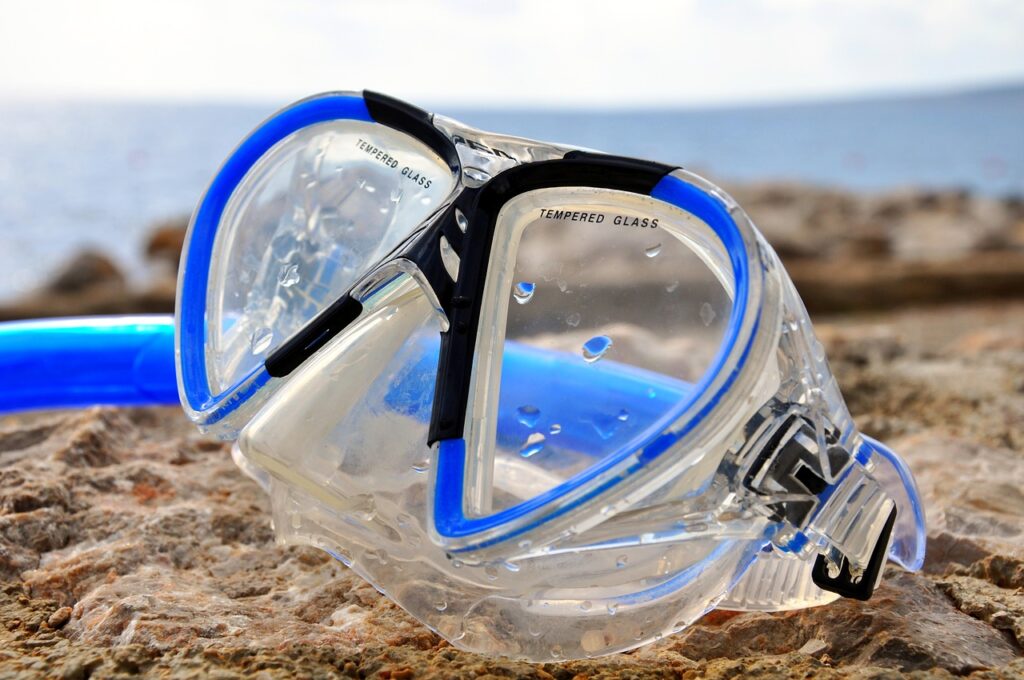
The fundamental distinction between snorkeling and scuba masks lies in their glass composition and adherence to pressure safety standards. Scuba masks utilize tempered glass that undergoes rigorous testing to withstand substantial underwater pressures, while snorkeling masks often employ acrylic or standard plastic materials suitable only for surface activities. These material differences directly correlate with specific safety certifications that determine whether a mask can safely protect users at various depths.
Tempered Glass Benefits
When examining plunging mask construction materials, tempered glass emerges as the gold standard for underwater safety equipment owing to its superior strength properties and controlled failure characteristics. This specialized glass undergoes heat treatment processes that dramatically increase impact resistance, making scuba diving masks exponentially safer during underwater exploration. The material’s engineered fracture pattern produces small, blunt fragments rather than dangerous shards when breakage occurs.
| Tempered Glass Feature | Safety Benefit |
|---|---|
| Impact Resistance | Withstands underwater pressure changes |
| Controlled Fracture | Creates blunt pieces, not sharp shards |
| Optical Clarity | Minimizes underwater visual distortion |
| Regulatory Compliance | Meets mandatory diving safety standards |
Rigorous testing guarantees these masks meet stringent safety standards, providing adventurous divers the reliability needed for confident underwater exploration while maintaining exceptional visual clarity.
Safety Standard Requirements
Regulatory frameworks governing underwater mask construction establish distinct safety requirements that separate recreational snorkeling equipment from professional-grade scuba diving gear. Safety standards for scuba masks mandate rigorous testing protocols that evaluate pressure resistance, structural integrity, and failure thresholds under extreme conditions. These certifications guarantee dive masks can withstand significant depth pressures without compromising diver safety through rupture or catastrophic seal failure.
Quality control processes for scuba equipment involve thorough stress testing, material verification, and performance validation that snorkel masks typically bypass. Professional diving certification bodies require manufacturers to demonstrate consistent reliability across temperature variations, pressure differentials, and extended usage cycles. This stringent oversight creates measurable performance gaps between equipment categories, providing divers with confidence in their gear’s ability to perform reliably during challenging underwater adventures where equipment failure carries serious consequences.
Pressure Resistance and Depth Capabilities
While both mask types serve underwater activities, scuba diving masks like Pano 3 mask, demonstrate superior pressure resistance engineered for depths exceeding 30 meters, whereas snorkeling masks remain optimized for surface-level and shallow water applications.
The depth capabilities of each mask type stem from fundamental design differences. Scuba masks utilize tempered glass and high-grade silicone construction, enabling them to withstand extreme pressure differentials encountered during significant immersions. These materials maintain structural integrity under significant compression forces that would compromise standard snorkeling equipment.
Conversely, snorkeling masks typically employ plastic or acrylic components suitable for surface pressures but inadequate for deeper investigation. The pressure resistance requirements for scuba diving demand rigorous testing protocols that guarantee safe equalization during descent and ascent phases. This engineering precision grants divers the freedom to examine depths safely beyond recreational snorkeling limits.
Design Features for Equalization
Although pressure resistance forms the foundation of underwater mask engineering, equalization capabilities represent the vital operational distinction between scuba and snorkeling mask designs.
The plunge mask construction fundamentally differs based on depth requirements and equalization needs:
- Nose Pocket Integration – Scuba masks feature dedicated nose compartments enabling pressure equalization through nostril pinching, while snorkeling masks typically omit this significant feature.
- Airspace Minimization – Reduced internal volume promotes easier equalization and decreases buoyancy interference during descent.
- Silicone Skirt Quality – High-grade silicone guarantees watertight seals necessary for maintaining equalization effectiveness without disruption.
- Proper Fit Engineering – Precise facial contouring prevents water entry that compromises equalization procedures.
These design elements separate recreational snorkeling and scuba diving equipment, directly impacting underwater freedom and safety protocols.

Fit and Seal Requirements
Beyond equalization mechanisms, proper fit and seal requirements constitute the most critical safety factor distinguishing scuba and snorkeling mask applications. Scuba masks demand watertight seal integrity to withstand significant pressure variations at depth, requiring precise mask skirt contact against facial contours. Snorkeling masks accommodate looser tolerances since surface operations eliminate pressure concerns.
Optimal fit assessment involves placing the mask against the face without straps, inhaling gently to test suction retention. The mask skirt must conform to individual facial geometry without gaps or pressure points. Scuba applications necessitate stronger seal characteristics because of depth-related pressure changes, while snorkeling masks prioritize comfort over absolute seal perfection. Proper mask skirt selection matching facial contours guarantees leak-free operation, preventing water ingress that compromises underwater visibility and safety across both activities.
Volume and Buoyancy Considerations
Internal air volume represents a fundamental design distinction between snorkeling and scuba diving masks, directly impacting buoyancy characteristics and operational performance underwater.
Scuba diving masks feature reduced internal volume, delivering critical advantages for underwater freedom:
- Pressure Equalization – Minimal air space permits effortless equalization during descent, preventing discomfort and potential injury
- Buoyancy Control – Lower volume reduces unwanted positive buoyancy, allowing precise positioning and movement underwater
- Water Clearing – Less trapped air means faster, more efficient mask clearing when water enters
- Stability Improvement – Reduced buoyancy forces eliminate mask displacement during complex maneuvers
Conversely, snorkeling masks maintain larger internal volume, creating increased buoyancy that can challenge submerged positioning. This design difference reflects each mask’s intended operational environment, with scuba diving masks prioritizing deep-water performance and extended underwater exploration capabilities.
Price Range and Value Differences
Price disparities between snorkeling and scuba plunging masks reflect fundamental differences in engineering requirements, material specifications, and safety standards. Snorkeling masks typically cost $20-$100, while scuba masks range from $50 to over $1,000. This price range difference stems from construction materials—snorkel masks often use plastic or acrylic components, whereas scuba masks require tempered glass for pressure resistance and safety compliance.
Good quality scuba masks justify higher costs through increased durability, superior comfort, and better visibility that directly impact diver safety. The investment reflects specialized engineering for deep-water exploration versus surface-level activities. While premium snorkel masks may incorporate plunge-mask features, they rarely meet scuba’s rigorous safety standards, making the price differential a reflection of intended use and performance requirements.
Testing and Certification Standards
While snorkeling masks operate under minimal regulatory oversight, scuba diving masks must undergo rigorous testing protocols and meet stringent certification standards established by international safety organizations.
Scuba masks face thorough evaluation procedures that snorkeling equipment typically bypasses:
- Pressure resistance testing – Masks endure simulated deep-water conditions to verify structural integrity under extreme pressure differentials
- Material certification – Tempered glass lenses and high-grade silicone seals must meet ISO or CE specifications for underwater durability
- Comfort and fit assessments – Extended wear trials guarantee proper sealing without compromising diver mobility or vision
- Safety compliance verification – Independent testing bodies validate that masks meet established diving safety protocols
These rigorous testing and certification standards create higher manufacturing costs but assure reliable performance during critical underwater situations. Certified scuba masks provide divers the confidence to investigate depths safely, while snorkeling masks remain suitable for surface-level recreational activities without equivalent safety assurances.
Intended Use and Activity Limitations
Although both mask types serve underwater activities, their operational parameters differ significantly based on depth limitations and environmental conditions. Snorkeling masks restrict users to surface-level exploration, typically within three feet of the water’s surface where natural breathing through attached snorkels remains feasible. A mask that fits properly for snorkeling may lack crucial pressure equalization features required for deeper descents.
Scuba diving masks accommodate substantial depth variations, enabling exploration beyond recreational limits while maintaining structural integrity under increasing water pressure. These masks must incorporate advanced sealing mechanisms and tempered glass construction to guarantee diver safety at various depths. The fundamental distinction lies in operational freedom: snorkeling masks limit users to shallow water observation, while equipment suitable for diving provides unrestricted underwater exploration capabilities with proper certification and training.
Durability and Longevity Expectations
The fundamental construction differences between scuba and snorkeling masks directly impact their operational lifespan and resistance to environmental stressors. Scuba masks utilize tempered glass and medical-grade silicone materials that undergo pressure testing protocols, ensuring structural integrity at depths where standard snorkeling equipment would fail. These material quality disparities result in measurable differences in replacement frequency, with scuba masks typically maintaining sealing effectiveness for multiple seasons while snorkeling masks often require annual replacement because of material degradation.
Material Quality Differences
When examining the construction materials used in underwater masks, scuba plunging equipment demonstrates superior engineering standards compared to snorkeling gear. The material quality differences between scuba masks and snorkeling masks reflect their intended operational environments and safety requirements.
Key material distinctions include:
- Lens Construction: Scuba masks utilize high-quality tempered glass that resists shattering and pressure changes, while snorkeling masks often feature cheaper acrylic or plastic lenses prone to scratching and damage.
- Silicone Quality: Professional plunge masks employ premium-grade silicone for watertight seals and extended longevity, contrasting with lower-grade rubber commonly found in snorkel equipment.
- Safety Standards: Plunge masks undergo rigorous pressure testing to meet stringent regulations, unlike snorkeling masks.
- Investment Value: Superior scuba mask materials deliver improved performance and extended lifespan compared to budget-oriented snorkeling alternatives.
Pressure Resistance Testing
Beyond material composition, rigorous pressure resistance testing separates professional scuba masks from recreational snorkeling equipment with respect to performance reliability and safety standards. Scuba masks undergo thorough evaluation to withstand pressures up to 4-5 atmospheres, equivalent to 120-150 feet underwater depths. This testing validates seal integrity and lens durability under simulated diving conditions, ensuring watertight performance when exploring deeper waters.
Conversely, snorkeling masks typically bypass such stringent pressure resistance testing protocols, limiting their operational effectiveness in high-pressure environments. The testing process examines tempered glass lenses and seal mechanisms under controlled pressure scenarios, identifying potential failure points before equipment reaches divers.
This fundamental difference allows confident exploration of underwater realms, where equipment reliability directly impacts safety and diving experience quality in challenging aquatic environments.
Expected Lifespan Comparison
Although both mask types serve underwater exploration purposes, their expected lifespans differ substantially due to fundamental construction disparities and intended operational environments.
Scuba masks demonstrate superior longevity through premium tempered glass and silicone construction, typically lasting 5-10 years with proper maintenance. Their rigorous testing standards guarantee resilience against deep-water pressures and harsh underwater conditions. Snorkel masks, manufactured with cost-effective materials for surface applications, typically deteriorate within 1-3 years.
Critical lifespan factors include:
- Material quality – Premium components versus budget alternatives
- Construction standards – Pressure-tested durability versus basic surface requirements
- Environmental exposure – Deep-water resilience versus shallow-water limitations
- Maintenance protocols – Fresh water rinsing and UV protection extending operational life
Freedom-seeking divers benefit from investing in equipment matching their exploration ambitions and operational demands.