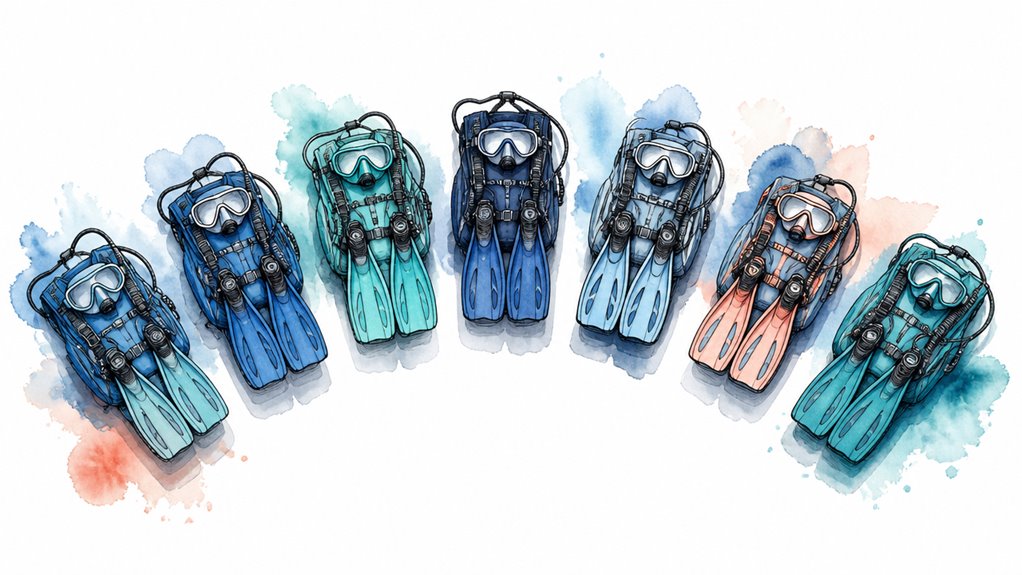
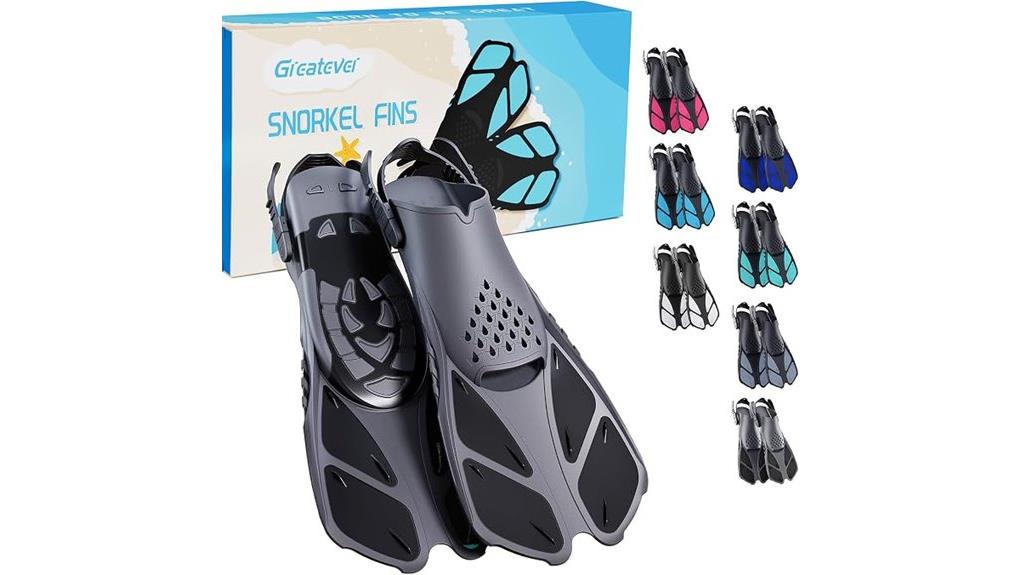
Scuba fins feature shorter blades (25-30 inches) with open heel designs and durable, stiffer materials for maneuverability in confined spaces. Freediving fins utilize longer blades (31-38 inches) with full foot pockets and lightweight materials like carbon fiber for peak propulsion efficiency in open water. The blade length directly impacts performance characteristics, with shorter fins prioritizing control and longer fins maximizing thrust. Understanding these fundamental differences guarantees proper equipment selection for ideal safety and performance in specific diving environments.
Key Takeaways
- Scuba fins have shorter blades (25-30 inches) with open heels, while freediving fins feature longer blades (31-38 inches) with full foot pockets.
- Freediving fins use lightweight materials like carbon fiber for efficiency, whereas scuba fins employ stiffer, more durable construction.
- Longer freediving fin blades provide superior propulsion and energy conservation ideal for open water and distance swimming.
- Scuba fins offer better maneuverability in confined spaces and complex underwater environments due to their shorter blade design.
- Proper fit is crucial for both types, with freediving fins requiring snug barefoot fit and scuba fins accommodating protective boots.
Key Design Differences Between Scuba and Freediving Fins
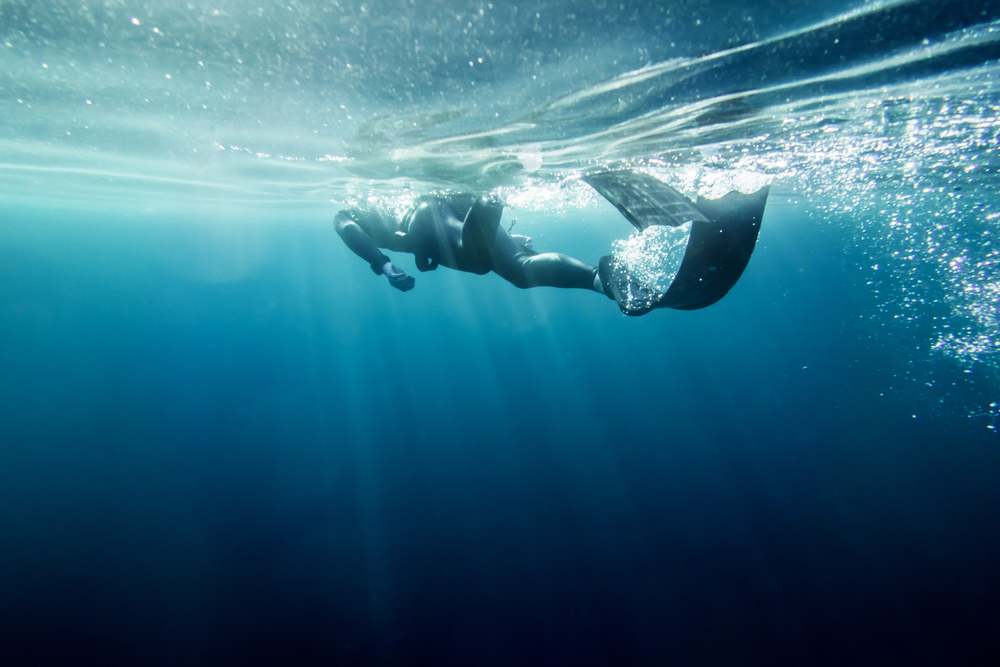
The fundamental distinction between scuba and freediving fins lies in their blade geometry and construction materials. Freediving fins feature extended blades measuring 31-38 inches, constructed from advanced materials like carbon fiber or fiberglass to maximize propulsion efficiency during vertical descents. These design differences facilitate rapid acceleration and gliding capabilities crucial for breath-hold diving. Conversely, scuba fins utilize shorter 25-30 inch blades made from thicker, more flexible materials prioritizing durability and comfort during extended underwater excursions. The foot pocket configurations reflect each discipline’s requirements: freediving fins employ full foot pockets for secure attachment, while scuba fins typically feature open heel designs accommodating protective diving boots. This engineering divergence directly impacts performance characteristics, with each fin type optimized for its respective diving methodology’s specific demands and safety considerations.
Length and Blade Characteristics
The most pronounced distinction between scuba and freediving fins lies in their blade length measurements, with freediving fins extending 31 to 38 inches compared to scuba fins’ 25 to 30 inches. This significant length differential directly correlates to surface area variations that fundamentally alter propulsion efficiency and water displacement capabilities. These dimensional characteristics determine each fin type’s suitability for specific underwater activities and safety requirements.
Blade Length Differences
When comparing fin blade dimensions, freediving fins demonstrate significantly longer blade lengths, typically measuring between 31-38 inches, while scuba fins feature considerably shorter blades ranging from 25-30 inches. This substantial difference directly impacts propulsion efficiency and energy consumption patterns during underwater activities.
| Fin Type | Blade Length | Surface Area | Primary Advantage |
|---|---|---|---|
| Freediving fins | 31-38 inches | Maximum | Superior hydrodynamics |
| Scuba fins | 25-30 inches | Moderate | Improved maneuverability |
| Hybrid models | 28-32 inches | Variable | Balanced performance |
The extended blade length of freediving fins increases surface area substantially, enabling powerful water displacement with each kick cycle. This design prioritizes hydrodynamics and gliding efficiency, though requiring refined kicking technique. Conversely, scuba fins’ shorter blades accommodate equipment constraints while maintaining adequate propulsion for recreational diving scenarios.
Surface Area Impact
Beyond dimensional measurements, surface area calculations reveal the fundamental performance differences between fin designs. Freediving fins maximize surface area through their long blade construction, creating superior hydrodynamics that translate directly into improved propulsion efficiency. This expanded surface area allows freedivers to generate maximum thrust while conserving oxygen—critical for extended breath-hold descents.
Scuba fins feature reduced surface area, prioritizing maneuverability over raw power output. Their compact design supports precise movements around underwater obstacles and equipment management scenarios. The hydrodynamics of smaller surface area fins produce controlled propulsion suitable for technical diving operations.
Surface area directly correlates with energy transfer efficiency in aquatic environments. Long freediving fins exploit this principle, allowing divers to achieve greater distances per kick cycle, ultimately extending underwater exploration capabilities while maintaining ideal physiological performance standards.
Material Construction and Durability
Material composition fundamentally determines a fin’s performance characteristics, longevity, and suitability for specific diving applications. Scuba diving fins utilize stiffer, thicker materials engineered for durability and consistent propulsion when maneuvering with heavy equipment. Freediving fins prioritize lightweight material construction, ranging from affordable plastic to premium carbon fiber variants. Plastic fins offer entry-level accessibility but may deform over extended use. Carbon freediving fins deliver exceptional performance and flexibility, yet demand careful handling because of their natural fragility. Fiberglass provides ideal balance between durability and responsiveness.
Material selection directly impacts power transfer efficiency:
- Stiffer materials generate greater thrust but require increased muscle strength and technique
- Carbon fiber maximizes performance while minimizing weight penalties
- Plastic construction offers cost-effective introduction with compromised longevity expectations
Advanced materials facilitate improved underwater freedom through refined energy transfer and reduced fatigue.
Foot Pocket Design and Fit Considerations
Foot pocket architecture serves as the critical interface between submersible and fin, with design variations reflecting each discipline’s distinct operational requirements. Scuba fins employ open heel configurations accommodating protective boots, vital for thermal regulation in challenging environments. Conversely, freediving fins utilize full foot fins design, eliminating unnecessary weight while maximizing direct power transfer. The foot pocket must fit snugly without gaps to prevent energy loss and cramping during extended sessions.
Freediving equipment incorporates softer rubber compounds tailored for barefoot operation, while scuba fins feature reinforced materials supporting thicker boot systems. Different types of fins demand precise sizing compatibility between pocket dimensions and blade specifications. Proper foot pocket selection guarantees high efficiency kicks, allowing aquatic adventurers to achieve ideal propulsion while maintaining comfort throughout their underwater explorations.
Performance and Efficiency in Different Diving Conditions
When evaluating fin performance across diverse underwater environments, blade length emerges as the primary determinant of propulsive efficiency and operational suitability. Freediving fins, featuring longer blades spanning 31-38 inches, deliver superior propulsion and energy conservation through reduced kick frequency. Their stiffness facilitates high acceleration with minimal drag, making them ideal for open water conditions and dynamic movements where covering extensive distances is paramount.
Conversely, scuba fins utilize shorter 25-30 inch blades providing moderate propulsion suited for precision maneuvers in confined spaces like caves or wrecks. Nevertheless, their bulkiness compromises kick efficiency, potentially causing faster fatigue.
- Open water diving conditions: Freediving fins excel through improved energy conservation and long-distance capability
- Confined environments: Scuba fins offer superior control for steering through restricted spaces
- Current resistance: Longer blades provide greater thrust against strong underwater currents
Choosing the Right Fins for Your Diving Style
How does one navigate the critical decision between freediving and scuba fins to maximize underwater performance? The selection process demands careful assessment of personal swimming style and operational requirements. Divers must evaluate their primary activities: depth-focused freediving requires maximum propulsion efficiency, while scuba operations prioritize manoeuvrability around equipment and obstacles.
| Factor | Freediving Fins | Scuba Fins |
|---|---|---|
| Primary Use | Open water depth | Technical navigation |
| Foot Pockets | Full foot design | Open heel with boots |
| Performance Focus | Maximum propulsion | Improved control |
Comfort and fit remain paramount safety considerations. Ill-fitting foot pockets compromise performance and increase fatigue risk. Divers should prioritize snug fitting without pressure points, ensuring peak power transfer. The choice ultimately depends on whether the diver values raw propulsion for reaching depth or precise manoeuvrability for complex underwater environments.